Executive Summary
Gross-to-Net (GTN) is one of the most underestimated risks in generic pharmaceutical finance.
For emerging and mid-market generics companies, the question is rarely whether GTN matters ; it is when complexity crosses the line from manageable to material.
Oracle NetSuite is often positioned as either a complete GTN solution or entirely insufficient. Both views are wrong.
Archer Insights’ point of view is simple:
- NetSuite is an excellent financial foundation for Gross-to-Net
- It is not a purpose-built GTN calculation engine
- The winning strategy is phased, audit-first, and scale-aware
When implemented correctly, NetSuite can:
- Support GTN accruals and controls
- Serve as the system of record for revenue and liabilities
- Provide a clean audit trail under ASC 606
As GTN complexity grows, NetSuite should not be replaced ; it should be paired with a specialized GTN platform such as Model N or Revitas.
Archer helps generics companies design this journey deliberately, avoiding over-engineering early and rework later.
1. What Makes GTN Hard in Generics
This section intentionally focuses on operational reality, not theory.
GTN complexity in generics is driven by:
- Chargebacks (high volume, contract-driven, retrospective)
- Government programs (Medicaid, Medicare Part D, 340B)
- Channel mix volatility (wholesalers, specialty, direct)
- Time lag between shipment, claim, and settlement
- Auditor scrutiny under ASC 606
Any system supporting GTN must handle:
- Accrual estimation at time of sale
- Claim validation and reconciliation
- Periodic true-ups
- Transparent assumptions and controls
2. When NetSuite Is a Good Fit for GTN
NetSuite is a good fit when GTN complexity is real but still manageable.
Typical Company Profile
-
Early to mid-stage generics company
-
Limited product portfolio (generally < 20 SKUs)
-
Primary distribution through 1–3 wholesalers
-
Contract structures are relatively stable
-
Government exposure exists but is not dominant
-
Finance team is hands-on and process-driven
GTN Characteristics
- Chargebacks are material but not overwhelming in volume
- Accruals can be estimated using historical percentages
- Rebates and returns are predictable
- Quarterly true-ups are acceptable
Why NetSuite Works Here
In this scenario, NetSuite can:
- Act as the system of record for revenue and accruals
- Provide clean audit trails and SOX-aligned controls
- Support GTN via:
- Custom accrual logic
- Contract and pricing masters
- Chargeback validation workflows
- Period-end true-up journal entries
The key is that GTN is engineered as a process, not expected to be “native.”
3. NetSuite’s Role When It Is a Good Fit
When NetSuite is a good fit, it typically plays three critical roles:
1. Financial System of Record
- Books gross revenue
- Holds GTN accrual liabilities
- Posts adjustments and true-ups
- Supports multi-book (GAAP vs management)
2. GTN Accrual & Control Framework
- Accruals calculated at shipment or invoicing
- Assumptions stored and version-controlled
- Clear linkage between sales, accruals, and settlements
3. Audit & Compliance Backbone
- Documented GTN methodology
- Repeatable month-end process
- Strong traceability from estimate → actual
In this model, NetSuite is not trying to outsmart GTN. It is enforcing discipline, consistency, and financial integrity.
4. When NetSuite Is Not As Good A Fit As The GTN Engine
NetSuite alone becomes insufficient when GTN complexity outpaces percentage-based estimation.
Typical Company Profile
- Mid-to-large generics manufacturer
- Large SKU count with frequent launches
- Heavy Medicaid, Medicare Part D, and 340B exposure
- Multiple GPO, PBM, and government contracts
- High chargeback claim volumes
- Aggressive pricing changes
GTN Characteristics
- Accrual accuracy materially impacts earnings
- Chargebacks are contract-specific and claim-driven
- Government programs require statutory logic
- Forecasting and analytics are critical
- Auditors expect system-level controls
In this environment, GTN is no longer just accounting ; it is a core commercial operation.
5. NetSuite’s Role When It Is Not the GTN Engine
Even when NetSuite is not the GTN calculation engine, it still plays a central role.
NetSuite as the Financial Anchor
- Remains the general ledger and AR/AP system
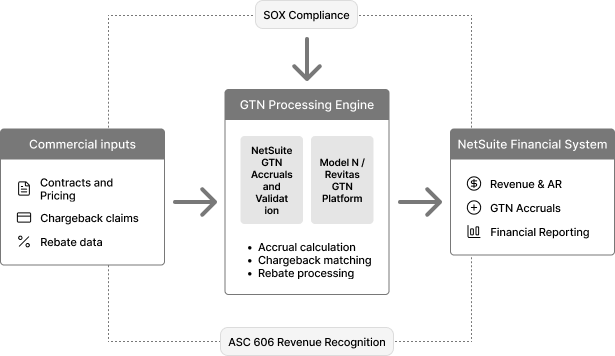
- Receives summarized GTN results from a GTN platform
- Maintains statutory and management reporting
GTN System as the Calculation Engine
- Specialized GTN platforms handle:
- Chargeback adjudication
- Medicaid and 340B logic
- Contract price validation
- Forecasting and scenario modeling
Integration Model
- GTN system calculates detailed deductions
- NetSuite preserves audit traceability
- NetSuite posts:
- Accruals
- Settlements
- Adjustments
In this model, NetSuite governs the money, while the GTN platform governs the math.
6. Common Mistakes to Avoid
- Expecting NetSuite to be a plug-and-play GTN solution
- Overbuilding GTN logic too early
- Underestimating audit expectations
- Treating GTN as a one-time implementation
- Letting GTN calculations live outside controlled systems (spreadsheets)
7. Practical Decision Framework
| Question | If “Yes” | If “No” |
|---|---|---|
| Is GTN manageable with estimates? | NetSuite-led GTN | Dedicated GTN platform |
| Is government exposure limited? | NetSuite viable | NetSuite + GTN system |
| Are auditors comfortable with process-based controls? | NetSuite works | Specialized tooling needed |
| Is SKU/contract growth expected soon? | Stage NetSuite first | Plan GTN integration early |
8. What Companies need to be aware of
- NetSuite is a strong foundation for Gross-to-Net ; not a silver bullet
- GTN success depends on controls, assumptions, and audit defensibility
- The smartest approach is phased: NetSuite first, specialized GTN tooling later
- Archer’s role is to design, implement, and govern this evolution end to end
The smartest approach is often phased: start with NetSuite-led GTN, then integrate a specialized GTN platform as scale and exposure demand it.
9. Archer Insights Point of View and Positioning
Archer Insights approaches Gross-to-Net not as a software configuration exercise, but as a commercial-to-finance operating model problem.
Most GTN failures do not come from the math. They come from:
- Poor contract structure
- Weak linkage between commercial strategy and finance
- Accrual logic that auditors cannot follow
- Over-engineering too early or under-engineering too late
Archer’s positioning is intentionally pragmatic:
- NetSuite first, but not NetSuite forever
- Design GTN as a scalable control framework
- De-risk future GTN platform adoption
Archer’s GTN Philosophy
Archer believes:
- NetSuite should always be the financial system of record
- GTN logic should mature in phases
- Specialized GTN platforms should be added only when economic and audit risk justify it
This avoids the two most common mistakes in generics:
- Implementing a heavy GTN platform too early
- Letting GTN live in spreadsheets for too long
Archer’s Phased GTN Roadmap
Phase 1: NetSuite-Led GTN Foundation
- GTN accrual framework inside NetSuite
- Contract and pricing master design
- Chargeback intake and validation workflows
- SOX- and audit-ready documentation
Phase 2: Hybrid GTN Model
- Introduce Model N or Revitas for calculation complexity (Archer does not sell this)
- NetSuite remains the GL and control layer
- Clear ownership split between systems
Phase 3: Scaled GTN Operations
- GTN platform becomes calculation engine
- NetSuite becomes the financial authority
- Archer governs integration, controls, and audit alignment
10. NetSuite vs Model N / Revitas Responsibility Split
The table below reflects Archer’s recommended system-of-responsibility model, not marketing claims.
| GTN Function | NetSuite Responsibility | Model N / Revitas Responsibility |
|---|---|---|
| Gross revenue recognition | System of record | Not applicable |
| GTN accrual posting | Yes (GL impact) | Provides calculated values |
| Contract master (financial view) | Yes | Sync / reference |
| Contract adjudication logic | Limited | Primary engine |
| Chargeback validation | Basic / workflow | Advanced rules & validation |
| Medicaid rebate calculation | Not native | Primary engine |
| Medicare Part D logic | Not native | Primary engine |
| 340B pricing & eligibility | Not native | Primary engine |
| Forecasting & scenario modeling | Limited | Advanced analytics |
| Period-end true-ups | Yes | Provides supporting detail |
| Audit trail & SOX controls | Primary owner | Supporting detail |
| Cash application & settlement | Yes | Feeds settlement data |
11. How Archer Typically Positions This with Clients
We position the conversation around:
- Risk (earnings volatility, audit exposure)
- Timing (when complexity actually hits)
- Control (who owns the numbers)
Our typical guidance:
- If GTN errors are annoying, NetSuite-led GTN is sufficient
- If GTN errors are material, a GTN platform is justified
- In all cases, NetSuite remains the financial backbone
This keeps CFOs, auditors, and commercial leaders aligned, and avoids rework.
12. Key Implementation Takeaways
- NetSuite is an excellent foundation for Gross-to-Net
- It should never be treated as a silver bullet
- The winning strategy is phased, intentional, and audit-first
Archer’s role is to:
- Design the GTN operating model
- Implement NetSuite to support it
- Integrate GTN platforms when and only when they are justified
Appendix: Questions Auditors Will Ask (and How Archer Designs for Them)
1. How are GTN accrual percentages determined?
Expectation: Historical data, documented methodology, periodic review.
2. How do you validate chargebacks against contracts?
Expectation: System-based validation, not spreadsheets.
3. How do you ensure completeness of GTN liabilities?
Expectation: Controls tying shipments to accruals.
4. How are estimates trued up to actuals?
Expectation: Consistent, period-based true-up process.
5. Who owns GTN assumptions and approvals?
Expectation: Clear ownership and version control.
6. What happens when contracts or pricing change mid-period?
Expectation: Controlled updates with documented impact.
7. How does the GTN system integrate with the GL?
Expectation: Clear system-of-record definition.
8. Can you trace a dollar from gross sale to net revenue?
Expectation: End-to-end traceability.
9. How do you prevent management override of GTN estimates?
Expectation: Controls, approvals, and audit logs.
10. How does your GTN approach scale as volume grows?
Expectation: Roadmap, not heroics.